Chromotherapy: What the Coloured Lights in Our Sauna Are For
The lights are not decoration, and they are not medicine either. Here is the honest middle ground.
The first time most people sit in our full spectrum sauna, the coloured light is the thing they ask about. It is also the thing most likely to get an eye-roll, which is fair — colour therapy has been oversold by plenty of people who should know better.
So here is what it actually is, what it is not, and why we think it earns its place anyway.
What chromotherapy is
Chromotherapy — colour therapy — is the practice of using coloured light with the intention of influencing how you feel. The framing used in the sauna world is that colour is a frequency of light, and that different frequencies are associated with different qualities of experience.
The practice is old. Colour has been used deliberately in healing traditions across Egypt, India and China for a very long time, and the modern sauna version is a descendant of that lineage rather than a new invention.
What each colour is traditionally used for
Red — energy, circulation, stimulation. The most activating end. Good early in a session or on a morning visit.
Orange — warmth, creativity, appetite for life. Sociable and uplifting without being as intense as red.
Yellow — clarity, optimism, digestion. Associated with mental brightness. Useful on a grey February afternoon in the U.P., when brightness is in short supply.
Green — balance and calm. Sits in the middle of the visible spectrum and is traditionally treated as the neutral, restorative colour. A safe default.
Blue — cooling, calming, sleep. The most requested colour in evening sessions, and for good reason.
Indigo — stillness and focus. Associated with quieting mental chatter.
Violet — deep rest and inward attention. The far end of the spectrum, traditionally used for meditative states.
What the evidence does and does not say
We would rather be straight about this than sell you something.
Chromotherapy as practised in a sauna is not a clinically validated medical treatment. It does not cure anything and there is no serious body of evidence saying it does. Anyone claiming otherwise is going further than the science supports.
But light genuinely affects human beings, and that part is not in dispute. Light exposure regulates circadian rhythm. Blue-enriched light in the evening is well documented to interfere with sleep onset, which is why your phone has a night mode. Bright light therapy has a real evidence base for seasonal affective disorder — something the Keweenaw has an above-average interest in.
So the honest position is somewhere in between. Colour affects mood and state; the specific claims made about individual colours are traditional rather than clinical. Enjoy it as an atmospheric and psychological part of the experience rather than as a treatment, and it delivers exactly what it should.
How to actually use it
Choose by intention, not by favourite colour. Ask what you want from this session, not what looks nice.
- Evening session, want to sleep well: blue or indigo.
- Morning session, want to start the day: red or orange.
- February, feeling flat: yellow or orange.
- Stressed and wired: green or blue.
- Recovering after heavy physical work: green.
- No idea: green. It is the neutral one.
Stay with one colour. The most common mistake is treating it like a light show and cycling through everything. Whatever effect there is comes from settling into one state, not from changing it every ninety seconds.
Close your eyes. You still perceive the colour through your eyelids, without the visual stimulation. Most people find this considerably more relaxing.
Pair it with the session length. A 15-minute session is short enough that one colour is obviously right. On a 60-minute session, some people go red then green then blue, mirroring an arc from activation to deep rest.
Chromotherapy and winter
This is where we would make the strongest case. From November to March the Keweenaw gets short days and a lot of overcast. Whatever you think about colour theory, sitting in warm light for half an hour in the middle of a dark month is not nothing.
Our regulars who use the sauna hardest are winter users, and light is a meaningful part of why. Combined with the heat and half an hour with no screen, it is one of the more reliable mood interventions available in a Copper Country February.
Try it
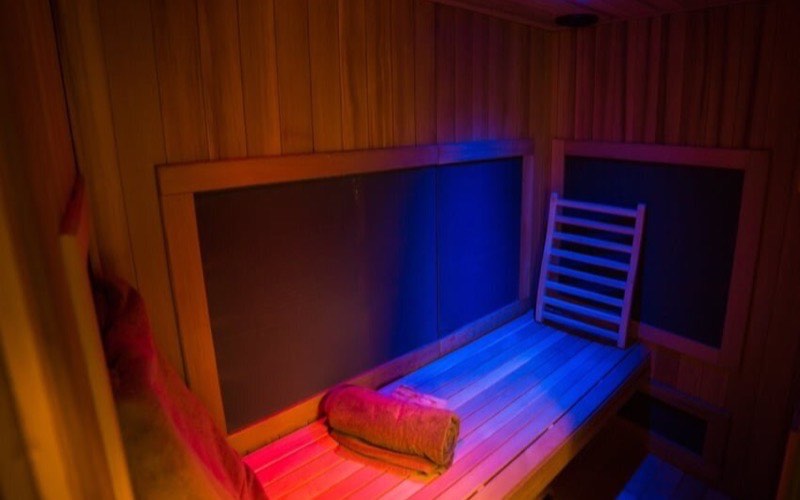
Chromotherapy is included with every session in our full spectrum infrared sauna at our Houghton location — no extra charge, and you choose the colour. Session lengths and packages are on the sauna page. If you are new to infrared, start with what a 30-minute session actually does.
Frequently asked questions
Chromotherapy is the use of coloured light during a sauna session, with different colours traditionally associated with different qualities — red with energy and circulation, blue with calm and sleep, green with balance. In our full spectrum infrared sauna it is included with every session and you choose the colour.
Chromotherapy is not a clinically validated medical treatment and does not cure anything. That said, light genuinely affects human physiology — circadian rhythm and mood both respond to light exposure — so it is best understood as an atmospheric and psychological part of the sauna experience rather than a therapy.
Choose by intention. Blue or indigo for an evening session when you want to sleep well; red or orange for a morning session or when you feel flat in midwinter; green when you are stressed, recovering, or unsure. Stay with one colour rather than cycling through them.
Yes. Chromotherapy lighting is part of every full spectrum sauna session at our Houghton location at no additional charge, along with access to a private spa shower with AVEDA products.
Come and see us in Houghton
Massage, full spectrum infrared sauna, wellness sessions and AVEDA salon services — book online, or call and talk it through first.
Keep reading
More from the Journal
 Sauna & Recovery
Full Spectrum Infrared vs. Traditional Sauna: What Is Actually Different?
In a region where sauna is practically a birthright, it is worth knowing why the infrared one feels so different.
Read the guide → Sauna & Recovery
How Often Should You Use an Infrared Sauna?
Consistency beats duration. Three short sessions a week will do more for you than one long one.
Read the guide →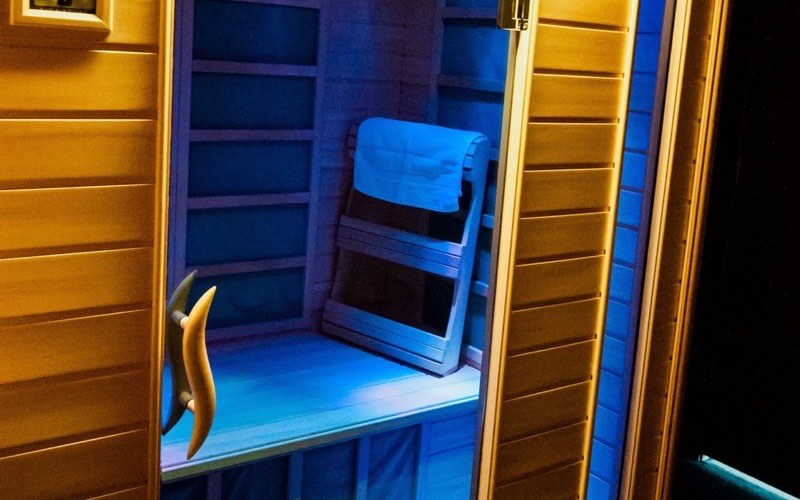 Sauna & Recovery
What 30 Minutes in a Full Spectrum Sauna Actually Does
Half an hour, no equipment, nothing required of you. Here is what is genuinely happening while you sit there.
Read the guide →